
The Symbolism of Getting Hitched on National Day in China
Tomorrow China turns another year older. In cities that keep the marriage desk open, couples want that birthday stamped into a little red book.
Article
Tomorrow morning, while terminals fill with suitcases, another queue will form somewhere quieter: the marriage registry.
October 1 is National Day, China’s birthday. In a normal year the civil-affairs offices close with everyone else, which is awkward if you want that exact date on your marriage certificate. So cities that see the demand reopen the desk for one holiday. Chengdu is keeping all twenty-three district and county marriage offices open from 9 a.m. to noon and 1 to 5 p.m., with online booking and walk-ups if the numbers fill. Shenzhen’s districts, aside from the Shen-Shan special cooperation zone, are treating October 1 as a working day for registration. Notices from Anhui to Shandong say it more plainly: bring IDs, bring three joint photos, come while the country is celebrating.
What people are lining up for is a small red book. In mainland China, marriage becomes legal at the 民政局, the civil affairs bureau, not at the banquet hall. Each spouse gets a passport-sized certificate nicknamed the 小红本. The party can wait a month. The date inside rides with you for life, on every form that asks when you married. That is why tomorrow’s stamp matters.
A lucky day without the almanac
Ask couples why October 1, and they rarely shrug.
Last National Day, Wuhan’s Changjiang Daily sent a reporter to the Wuchang district registry. Nearly a hundred couples registered that morning, about double the year before, most in their mid-to-late twenties. One pair had watched the flag rise on Tiananmen the previous October 1 and come back a year later to swear under the national emblem. Another bride said her parents had registered on October 1, 1994; she wanted the same date a generation on. “有大家才有小家,” she told the paper: only with the big family of the nation is the small family warm. A photographer who shoots registry days said her National Day slots had been booked for a month. She was packing extra flags.
For a long time, Chinese wedding dates ran through the lunar almanac: a 黄道吉日, an auspicious day picked with a calendar and sometimes a fortune-teller. National Day does not erase that habit. It gives couples a second kind of good day, one everyone already understands. You do not need a specialist to explain why the country’s birthday feels lucky. Fireworks over Victoria Harbour and packed high-speed trains already mark it. Putting your marriage on the same date means joining a celebration the whole country is already having.
Official campaigns have liked that rhyme for years. Mass-wedding slogans talk about 家国同庆见证幸福: the nation and the family celebrating together. Plenty of couples never quote the line. They still book the appointment, because an open counter on October 1 turns the feeling into ink.
Leave days and fluorescent light
The other half of the story is leave time.
October 1 falls inside the longest autumn break. If you work in Shenzhen or Shanghai but your household registration, your hukou, sits in another province, ordinary weekdays never gather both sets of parents and a clerk in one room. Golden Week finally does. Chengdu’s local reporting has quoted returnees who saved leave for exactly that: go home, finish the paperwork with the families present, then plan the banquet when everyone can breathe.
The appointment itself is short. Valid ID, three matching two-inch joint photos, and military paperwork if one of you serves. A few places dress it up. Jinzhai County in Anhui is running outdoor “love bay” registration by a tea-valley lake on October 1, with a boat ride after the stamp. Most couples get the ordinary room: fluorescent lights, a national emblem on the wall, a clerk who has already watched fifty red dresses walk through before lunch.
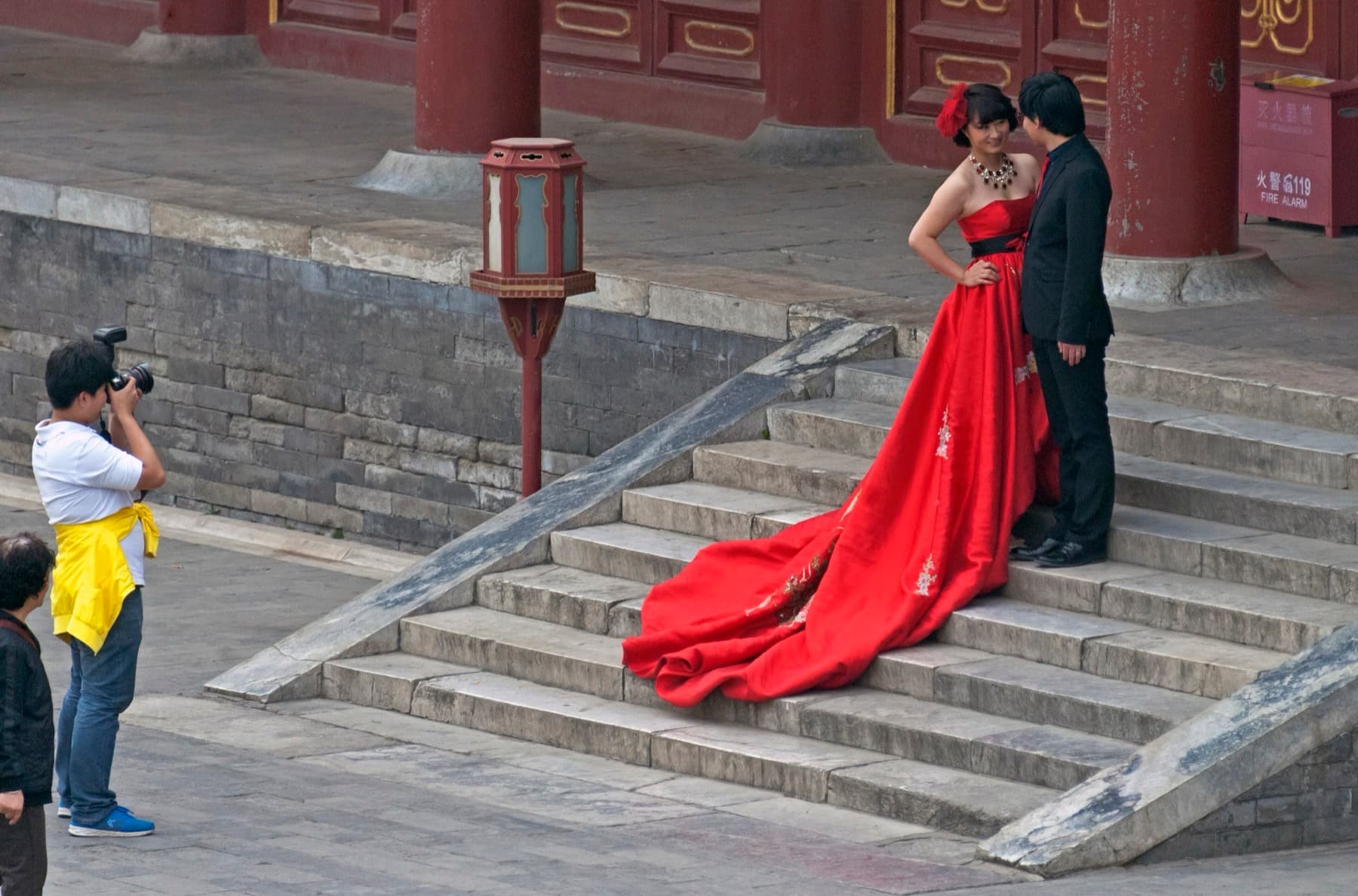
Then everyone wants a photograph. Heritage sites fill with wedding shoots in Golden Week for the same reason the registries do. Red photographs well against red pillars. Temple of Heaven steps, palace walls, riverside parks: backdrops for a date that already means something on paper. If you are visiting those places tomorrow, budget for tripods beside the tour groups.
If you want the date
Check your city’s civil-affairs notice before you buy the train ticket. Not every office opens. Where it does, book the appointment the minute the system allows, and print the joint photos in advance. Shenzhen and Chengdu both say a full online queue is not the end: show up with complete documents and you can still line up. Arrive early. The romance is the date. The crowd is everyone who had the same idea.
If you are only traveling through China this week, keep the same picture in mind. Golden Week is Seoul tickets and airport lines. It is also flag ceremonies, harbor fireworks, and couples treating the nation’s birthday as their own anniversary. Leave a little space at the registry plaza on October 1. Those red books are going home in jacket pockets.
Related stories
China's Golden Week Is Booking Seoul First
China can turn Mid-Autumn and National Day into a thirteen-day trip. More than half those outbound flights leave before October 1. The next rush is Tuesday, and Seoul is the city on the ticket.
6 min · Sep 27, 2026

Asians' Love Affair With Travel
Asian American and Asian Canadian households buy a lot of air. So do frequent flyers in China and India. The useful word is fluency: growing up with oceans in the family calendar makes leaving feel normal.
7 min · Sep 28, 2026

How to Choose a Hotel When You Are Traveling With Parents
Parent-friendly is not the same as boring.
3 min · Dec 10, 2025

How to Travel With Parents Who Remember a Different Country
Your parents' country may not exist anymore except in their stories.
3 min · Jul 15, 2025