
A First Two-Week Trip to Asia
Fourteen days from North America is enough for two cities done well. Here are three pairings that work, with nights, neighborhoods, budgets, and a predeparture checklist.
Why two gateways are enough
Two weeks is the most vacation most people from North America will ever spend in Asia on a single ticket, and that is exactly why it gets over-planned. Subtract the crossing in both directions and the two or three foggy days on the front end, and fourteen calendar days is closer to eleven days you will actually remember.
Eleven days is a lot for two big cities you can fly between in an afternoon. It is not enough to add Bangkok to Tokyo and Seoul because the map made them look adjacent.
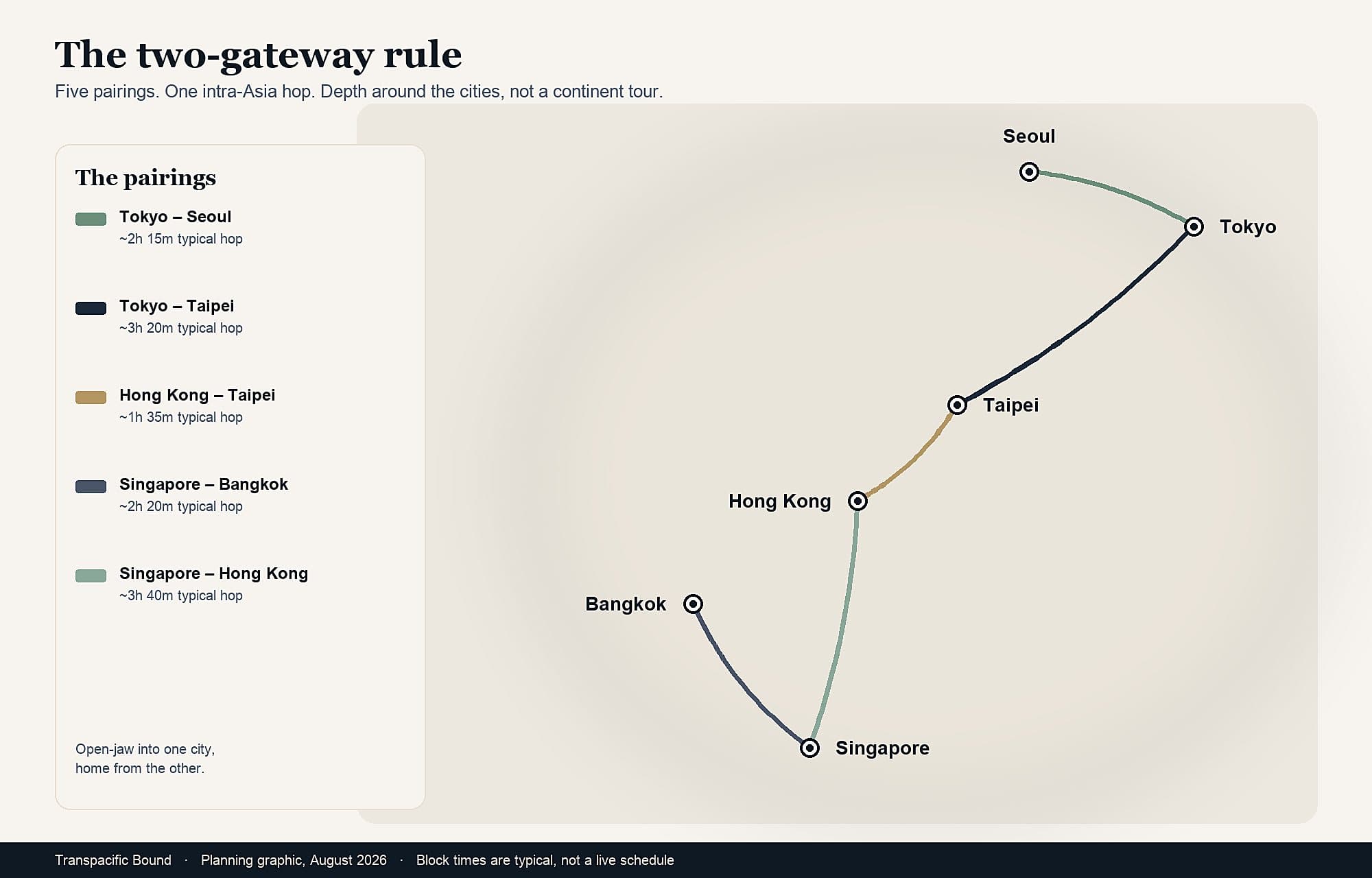
So: one city you fly into from North America, one city a short hop away, eight nights in the first and five or six in the second. We call this the two-gateway rule, and everything below is what it looks like once you put real dates on it. What fills the remaining days is depth—a train somewhere, one day trip, an afternoon in a neighborhood you already walked once—rather than a third international flight.
If family is the reason for the ticket, the family city is primary even when it is not the tourist capital. Everything else is optional.
Three pairings that work
Each of these pairs keeps the middle flight under two and a half hours and keeps you in one corner of the map. They give you enough contrast that the second city feels like a different country, without spending your recovered energy in another airport.
One counting note before the details: measure in hotel nights after you land, not in days off work. Fourteen days of leave is usually eleven or twelve real days on the ground.
| Pairing | Nights | Flight between | Who it suits |
|---|---|---|---|
| Tokyo + Seoul | 8 + 5 (or 7 + 6) | ~2h 15m | Eaters who don’t mind big, fast, crowded cities |
| Taipei + Hong Kong | 8 + 5 | ~1h 35m | Nervous first-timers who still want real density |
| Singapore + Bangkok | 7 + 6 | ~2h 20m | An easy landing first, then heat and appetite |
Hop times are typical published block times. Confirm the live schedule before you lock the second hotel.
Tokyo and Seoul
This is the pairing most people picture when they say they want to go to Asia, and it holds up: two enormous capitals two hours apart, both of which reward you for eating on the street at eleven at night. Give Tokyo eight nights and Seoul five, and put the flight between them in the middle of the trip. From the West Coast, Tokyo is the obvious city to fly into. From the East Coast either works, as long as your arrival hour lets you stay awake into a local evening.
In Tokyo, base in Shinjuku if you want trains and late food in every direction, or Ueno if you want a softer residential rhythm and park air. Repeat one neighborhood instead of collecting wards. One day trip is plenty: Kamakura or Yokohama, not both. Leave Kyoto for a trip that starts with more sleep.
In Seoul, Jongno puts you near palaces and older streets without marooning you; Hongdae suits late walks and younger energy. Skip the instinct to book a DMZ morning on day two. Suwon or a neighborhood bathhouse will teach you more about whether you want to return.
The pacing that works here is one real plan before lunch, an afternoon with nothing in it, and dinner early enough that jet lag does not win the argument. Budget-wise, a comfortable midrange day—hotel, food, subway—tends to run $180 to $280 per person, on top of the long-haul ticket. The flight between the two cities can be anywhere from $80 to $250 one way, so price it separately rather than assuming your Pacific fare covers it.
Both cities punish a checklist and reward the traveler who is willing to eat the same thing twice. If you find yourself moving hotels to see one more district, you have already lost the trip.
Taipei and Hong Kong
This is the gentlest way into the region, and the one we suggest most often when someone is nervous. The flight between them is about ninety minutes, which barely counts as a travel day. Eight nights in Taipei and five in Hong Kong is the default split. Taipei forgives beginners—wrong train, wrong hour, wrong order of dishes, and you still eat well. Hong Kong rewards you once you have your legs, because it moves fast and expects you to keep up.
Stay in Zhongshan or Da’an in Taipei for MRT access without living inside a mall. Eat the same breakfast shop twice. Jiufen is a day trip; Tainan is an overnight only if you still have emotional bandwidth in week two. In Hong Kong, Sheung Wan or Central keeps you near the tram and the harbour; Tsim Sha Tsui works if Kowloon food is the point. One New Territories hike beats three Peak selfies.
Pacing stays gentle: night markets, one museum, lots of walking that does not require tickets. Midrange days often run about $140–220 per person before the long-haul. The hop is frequently the cheap part of the ticket on EVA, Cathay, or China Airlines—still buy it after you see the open-jaw math.
Choose this pair when you want the first trip to feel winnable, or when Taiwanese or Hong Kong family time is already on the calendar.
Singapore and Bangkok
Heat is the planning constraint, not the clock. Seven nights in Singapore and six in Bangkok keeps both cities honest. Fly into Singapore if you want English signage and hawker education first; reverse it only if Bangkok relatives are the reason for the ticket.
In Singapore, Tiong Bahru or the Kampong Glam side of town beats a pure financial-district hotel for evening walks. Learn one hawker centre by name. In Bangkok, Ari or a riverside hotel gives you an exit from absolute downtown intensity; do one temple cluster well instead of seven compounds poorly.
Mornings outdoors, afternoons in air-conditioning, evenings for food. Midrange budgets often sit around $120–200 per person per day, with Singapore lodging pulling the average up. The hop is about two hours twenty minutes; put it mid-trip.
Do not add Chiang Mai on this same ticket unless you are willing to cut Singapore or Bangkok to four nights—and four nights after a Pacific crossing is how people go home tired and slightly resentful.
Jet lag and day one
The good news is that flying west is the easier direction. The CDC, whose travel-health pages are the plainest official guidance on this, estimates that most people adjust about an hour and a half of clock per day going west and roughly an hour a day coming back east.
Run that against a real trip. Chicago to Taipei is a thirteen-hour swing in August, so a full adjustment takes most of the first week no matter how disciplined you are about melatonin and morning light. That is not a reason to shorten the trip; it is a reason to stop scheduling anything ambitious for days one through three.
Which means arrival day belongs to a convenience-store dinner, a walk around the block to see where you live now, and an early collapse. The sunrise temple photo will still be available on day four, when you can enjoy it. And put the hop to the second city somewhere around day six to eight, once you are a person again—never the morning after you land.
Money, phones, and getting around
Sort your phone before you leave the airport Wi-Fi: download the offline map, and have an eSIM or local SIM ready rather than discovering your roaming rate on day three. Then buy the transit card on your first morning. Japan has its IC cards, Taipei has EasyCard, Hong Kong has Octopus, Singapore has EZ-Link and SimplyGo, and Bangkok has the Rabbit card for the Skytrain—though Bangkok is the one city here where contactless bank cards and a taxi app may serve you better than a stored-value card.
Tapping a credit card works in most places across these six cities. Japan is the exception worth planning for: plenty of excellent small restaurants there still want cash, so keep some yen on you and treat the ATM in a convenience store as a normal errand. Elsewhere, carry a modest amount for markets, temple donations, and the stall that has never taken a card and never will. Tell your bank you are traveling, then stop converting every purchase in your head.
Entry rules are the one thing not to crowdsource. Check your own government’s country page—travel.state.gov for U.S. passports, the Government of Canada’s travel advice for Canadian ones—alongside the destination’s own immigration site, and do it a few weeks out rather than the night before. Several of these countries now want a form submitted before you arrive. Thailand’s digital arrival card is the one most first-timers run into, and it is free on the official government site, which is worth knowing because paid lookalike sites exist.
Food limits and moving through cities
If you have a serious allergy, write the phrase out in the local language before you go and keep it on your phone as an image, since you cannot count on data in a basement noodle shop. Milder preferences travel better with flexibility than with a prepared speech. And if street food makes you anxious, use the rule locals use: eat where the line is long and the food is cooked in front of you. One good meal outside the hotel usually settles the nerves for the rest of the trip.
Mobility constraints change the city choice more than the guidebook admits. Singapore, Taipei, and large parts of Tokyo and Seoul have elevators, step-free routes, and hotels near trunk transit. Bangkok can work with the right hotel and fewer stair-heavy temples. Build the day around bathroom access and shade, not around covering a map.
If family is part of the trip
Visiting relatives is a real itinerary, not a distraction from the “real” trip. Put one committed afternoon or dinner on the calendar and protect it. Do not turn fourteen days into seven obligatory meals that leave everyone polite and exhausted.
Gifts land better when they are small and specific—something that is actually from your city, rather than a suitcase of duty-free obligation.
The harder part to plan for is the emotional one. Two weeks will not resolve every question about identity or language, and walking into a grandparent’s kitchen may feel less like arrival than you expected, or much more. Fluency is not the same as belonging, and having none is not a disqualification. Learn a handful of phrases for taxis and menus anyway; they help even in cities where you can switch to English the moment you are back at the hotel.
What to pack by climate
Tokyo and Seoul in shoulder seasons want layers and a compact rain shell. Taipei and Hong Kong run subtropical—light clothes plus something for ferocious air-conditioning. Singapore and Bangkok are heat-first; add a cover-up for temples and one shirt that still looks presentable after humidity.
Pack for the walking day you will actually have, not for a photoshoot. Comfortable shoes beat a third dress jacket.
When a third city is allowed
Add a third stop only if all three of these are true: it is under about two hours away, you can still give it four nights once jet lag has taken its cut, and it deepens a place you already chose rather than adding a new country. Kyoto from Tokyo qualifies. Busan from Seoul, Chiang Mai from Bangkok, Penang or Melaka from Singapore—all fine. A second capital you are collecting does not.
If you have to ask whether the third city fits, it does not. Save it for the trip when you already know how you move.
Predeparture checklist
Print this, or screenshot it, and stop adding cities.
What success looks like
You come home able to give someone directions in one neighborhood of each city. You ate somewhere twice. You did not spend the Pacific crossing proving you could survive five airports.
Two weeks is a long first trip when you spend it on presence. It is a short one when you spend it on coverage. Pick the pair, protect the sleep, and leave a little undone on purpose.
Related stories
The Two-Gateway Rule for Planning a Transpacific Trip
Twelve days from North America is not permission to see Tokyo, Seoul, Bangkok, and Bali. Here is a planning rule, five pairings, and how 10-, 14-, and 21-day trips actually fit.
6 min · Aug 18, 2026
Your First Trip to Asia: A Culturally Fluent Starter Guide
How to pick your first Asian city, pace the week, and avoid turning the trip into heritage performance or continent tourism.
10 min · May 5, 2026

New and Returning Nonstop Flights Between North America and Asia
From Phoenix–Taipei and Dulles–Taipei to Chicago–Manila and a winter race into Sapporo, the 2026 nonstop list is thickening beyond the usual coastal hubs. Here is what is operating, bookable, or still just announced as of August 19.
7 min · Aug 19, 2026
Taipei Is the Soft Landing More Asian Travelers Should Choose First
Why Taipei teaches you how to travel Asia before harder cities test you.
7 min · May 12, 2026
Related global reads
Transpacific Bound
The Two-Gateway Rule for Planning a Transpacific Trip
Transpacific Bound
Your First Trip to Asia: A Culturally Fluent Starter Guide
East Table
East Asia cold noodles field guide
Goldsea
Asia’s 8 most romantic places and the great love stories behind them
Goldsea
The evolution of an Asian American