New and Returning Nonstop Flights Between North America and Asia
A late-summer map of the Pacific rebuild: which nonstops are already flying, which are only on sale, and which diaspora markets they actually change.

The Pacific timetable is getting denser again, and this time the interesting flights are not on the routes everyone already knows how to price.
The classic spine is still Los Angeles, San Francisco, Seattle, and Vancouver. What has changed in 2026 is the list of cities behind them that now have their own flight to Asia: Phoenix, Washington Dulles, Newark, Chicago. And for one winter season, two North American airports will serve a Japanese city that neither country has ever flown to nonstop—Sapporo. Some of these flights are in the air today. Others are on sale with a first departure still months out. At least one airline’s press release has already been overtaken by a competitor.
Everything below is current as of today, 19 August. Schedules move. Check the live booking engine before you buy a nonrefundable hotel.
Start with what you could fly tonight. Three new nonstops are already operating, and each one solves a different backtrack.
STARLUX Airlines, the young Taiwanese premium carrier, opened Phoenix–Taipei on 15 January—the first scheduled nonstop between Arizona and Asia, and the end of a mandatory drive or connection through Los Angeles for Valley travelers. Delta Air Lines came back to Hong Kong on 6 June with a daily Los Angeles flight, its first service to the city in years and a SkyTeam alternative on a route long shaped by Cathay Pacific. And on 26 June, EVA Air, Taiwan’s Star Alliance member, opened Washington Dulles–Taipei, the first nonstop between the U.S. capital region and Taipei. At roughly 7,800 miles, it is the longest nonstop the airport has ever had, according to the authority that runs Dulles.
So if you live in metro Phoenix, Southern California, or the D.C. suburbs, your search page genuinely changed this year. Everyone else still connects, which is fine. A thicker map is an option, not an obligation.
The next wave is sold but not yet flown, and that distinction is the whole point of this list.
United Airlines begins daily Newark–Seoul on 4 September, using a 787-9 with 257 seats on a westbound leg blocked at about fifteen hours forty-five minutes. It will not have the route to itself: Air Premia, the South Korean carrier that built its business on lower long-haul fares, already flies it. Price both before you assume the Star Alliance option is the better ticket.
On 24 October, United restores daily Chicago O’Hare–Tokyo Narita with a 787-8, a route it suspended during the pandemic and will now fly alongside its existing Chicago–Haneda service. One wrinkle worth knowing: Narita Airport’s own notice lists the Tokyo-origin start on 25 October, a day after the Chicago-origin launch. That gap is normal—the outbound and the return simply begin on different days—but read your ticket rather than the headline.
Philippine Airlines follows on 9 November with Chicago–Manila three times a week, its first nonstop from the Midwest. When the airline and the Chicago Department of Aviation announced the route in April, they advertised introductory round-trip economy fares from about $1,159, bookable only through the end of May. Treat that as a launch promotion that has already expired, not as tonight’s price.
Then there is the Hokkaido race, which is the most fun story on the list.
United will fly San Francisco–Sapporo three times weekly from 11 December to late March, the first nonstop between the continental United States and Hokkaido. Air Canada opens Vancouver–Sapporo on 17 December on a similar seasonal, three-times-weekly schedule with a 787. Air Canada announced first, in January, and called its flight the only nonstop linking North America and Sapporo. United’s May announcement quietly retired that claim before either airplane left a gate.
For skiers and Sapporo Snow Festival travelers, the choice is mostly which hub you can reach cheaply. For Japanese American and Japanese Canadian families with Hokkaido roots, it is the difference between a Tokyo landing plus a domestic hop with bags, and one immigration line straight into New Chitose.
| Airline | Route | Launch | Frequency / aircraft | Status |
|---|---|---|---|---|
| STARLUX | Phoenix – Taipei | 15 Jan 2026 | 3–4× wk / A350 | Operating |
| Delta | Los Angeles – Hong Kong | 6 Jun 2026 | Daily / A350-900 | Operating |
| EVA Air | Washington Dulles – Taipei | 26 Jun 2026 | 4× wk / 787-9 | Operating |
| United | Newark – Seoul Incheon | 4 Sep 2026 | Daily / 787-9 | Bookable |
| United | Chicago – Tokyo Narita | 24 Oct 2026 | Daily / 787-8 | Bookable (returning) |
| Philippine Airlines | Chicago – Manila | 9 Nov 2026 | 3× wk / widebody | Bookable |
| United | San Francisco – Sapporo | 11 Dec 2026 | 3× wk seasonal / 787-9 | Bookable |
| Air Canada | Vancouver – Sapporo | 17 Dec 2026 | 3× wk seasonal / 787 | Bookable |
Airline and airport announcements current through 19 August 2026. Frequencies and aircraft can change; confirm the live schedule before you lock hotels.
Who benefits is more specific than “people flying to Asia.”
Filipino families across Illinois, Indiana, Wisconsin, and Michigan have spent years buying Chicago tickets that still routed them through the West Coast or a Gulf hub before Manila. Three flights a week will not fix Christmas scarcity, but it removes a wasted night in a hotel nobody wanted to book.
Korean communities in New York and New Jersey now get a daily United-operated option into Incheon next to Air Premia’s cheaper one, which is a better position than choosing between a connection and a single carrier’s calendar. Taiwanese families and workers around Washington get a capital-to-capital flight instead of a backtrack to JFK. In Phoenix, the demand STARLUX talked about in its launch materials was partly the semiconductor corridor around TSMC’s Arizona plants—business traffic that used to start with a two-hour drive to LAX.
What a nonstop actually buys is time, not romance. It is landing in Manila close enough to schedule the cousin who is picking you up, instead of arriving wrecked after a coastal layover. It is skipping the bag reclaim at Narita and the domestic hop that eats your first morning of powder.
Fares deserve a method rather than a screenshot from someone else’s group chat. Compare the same two stretches of calendar every time you check: a midweek run in November, once the Chicago flights are supposed to be live but before the holiday crush, and a midweek run in March, at the tail of the Sapporo season. Price an open-jaw if you are flying home from the second city. On Newark–Seoul, put United and Air Premia side by side before you pay extra for the alliance. And read that Philippine Airlines intro fare as history—a floor the route once touched, not a number you can still buy.
Miles follow whoever operates the flight. United, Air Canada, and EVA all sit in Star Alliance. Delta’s Hong Kong return earns in SkyTeam. STARLUX belongs to none of the three, though American and Alaska partnerships came up around the Phoenix launch, which helps with connections more than with elite perks. And if your winter itinerary touches Asiana as a United partner, check our Korean Air–Asiana merger coverage first: Star Alliance earning on Asiana-operated flights is on a short clock this fall.
Airport details matter as much as aircraft type here. O’Hare is not Midway, and Dulles is not Reagan National—an easy and expensive mistake to make on a family booking. Narita and Haneda are genuinely different Tokyo experiences: Haneda is closer to the city, while United’s new Narita flight plugs into a wider connecting map across Asia and Micronesia. Sapporo means New Chitose, and if you are continuing on a separate Japan domestic ticket, give yourself real time for bags.
Nothing on this list has fallen apart at our cutoff. What has aged badly is marketing copy, especially that “only nonstop to Sapporo” line. A single technical diversion on an ultra-long flight is not a cancellation, either—it is a Tuesday. The things to check the week you buy are the fare class and which aircraft is actually assigned.
So: book the routes that are flying if the price looks honest. Hold September and December as real calendar dates you can plan around, with a little humility about how airlines revise them. The Pacific is filling back in. The job is still to buy the flight that matches the city where you will actually sleep.
Related stories

A First Two-Week Trip to Asia
Tokyo–Seoul, Taipei–Hong Kong, or Singapore–Bangkok: how to spend two weeks without turning the Pacific crossing into a continent tour.
9 min · Aug 19, 2026
Korean Air and Asiana Are Targeting a December Integrated Launch. Here’s What Travelers Should Watch Before Their Tickets Merge.
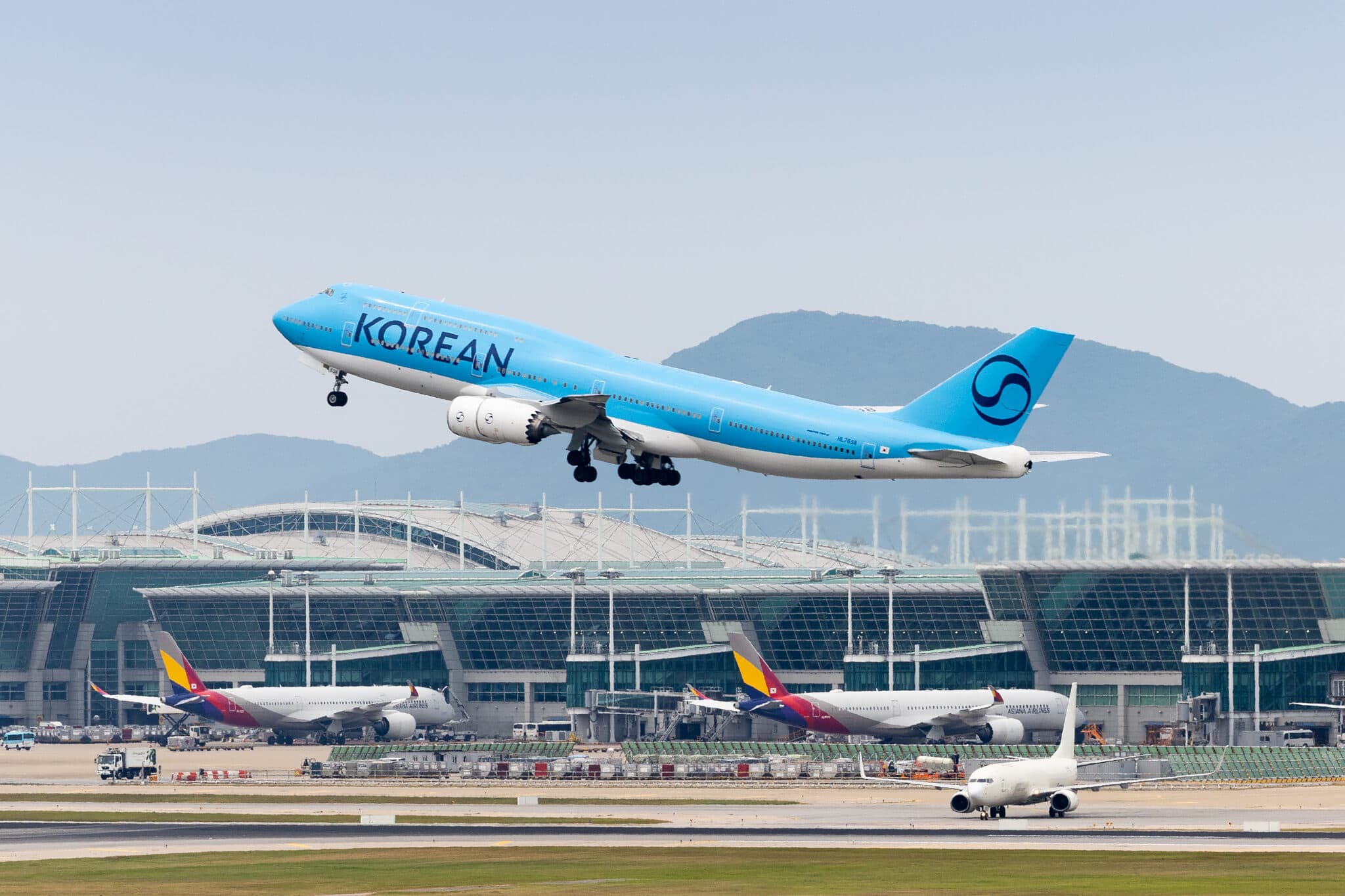
Korean Air and Asiana plan to become one company on December 17. The Incheon terminal move already happened. The mileage plan has not cleared the Fair Trade Commission, and Star Alliance earning on Asiana-operated flights ends in October.
6 min · Aug 17, 2026

What Actually Happens to Your Miles When Two Airlines Merge?
A legal merger and a mileage merger are different clocks. History says the surviving award chart usually wins. Korean Air and Asiana have not finished the second clock.
7 min · Aug 17, 2026
The Two-Gateway Rule for Planning a Transpacific Trip
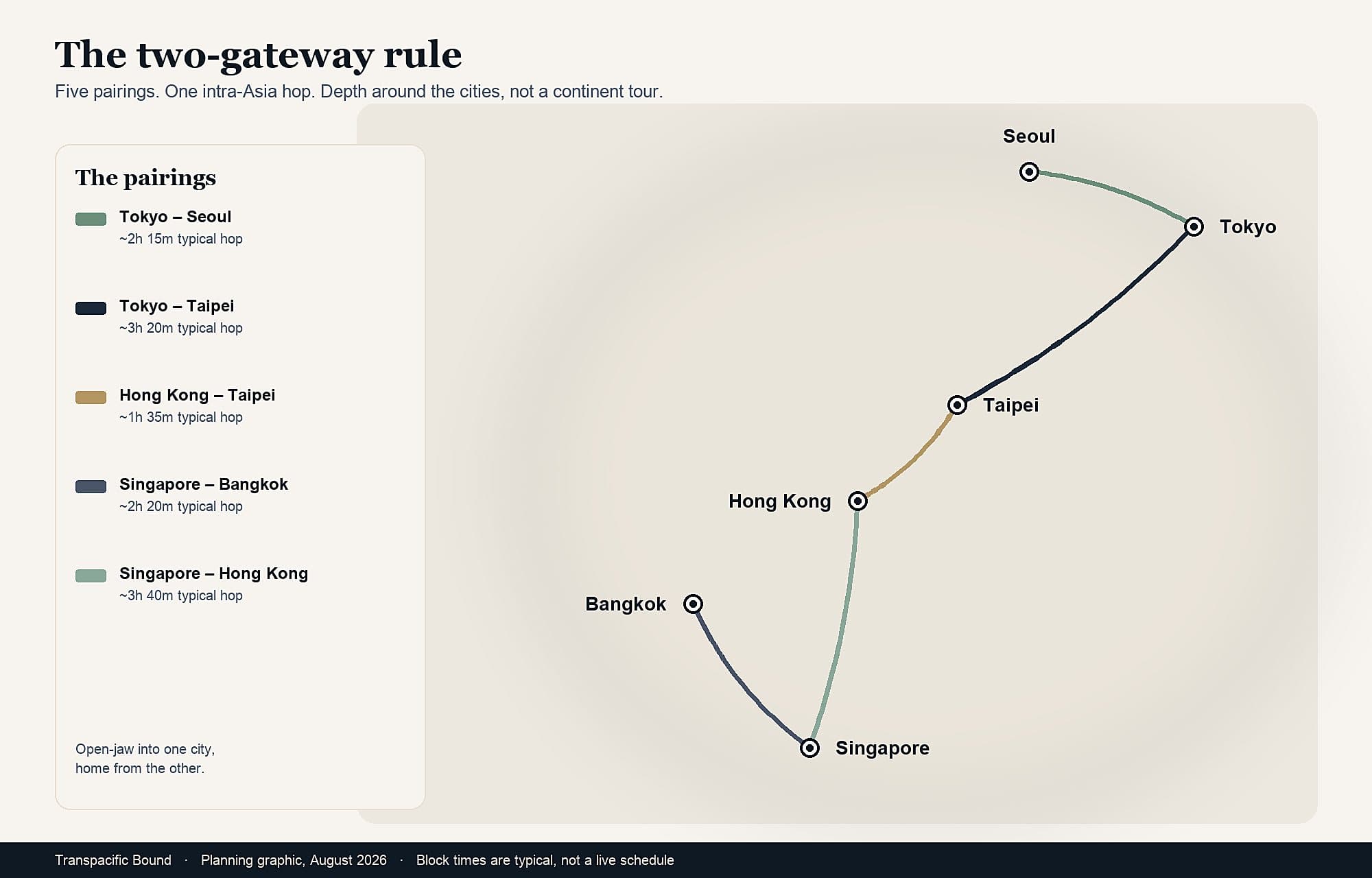
Twelve days from North America is not permission to see Tokyo, Seoul, Bangkok, and Bali. Here is a planning rule, five pairings, and how 10-, 14-, and 21-day trips actually fit.
6 min · Aug 18, 2026
Related global reads
Transpacific Bound
A First Two-Week Trip to Asia
Transpacific Bound
Korean Air and Asiana Are Targeting a December Integrated Launch. Here’s What Travelers Should Watch Before Their Tickets Merge.
East Table
East Asia cold noodles field guide
Goldsea
The evolution of an Asian American
East Table
Japan food consumption tax cut