
The Two-Gateway Rule for Planning a Transpacific Trip
Pick no more than two major cities you can fly between in an afternoon. Build regional depth around them. A third international flight is usually how the holiday disappears.
The rule
The expensive habit on a first transpacific trip is treating the ocean as permission to see a continent.
Twelve days looks generous on a kitchen calendar in California. After a twelve-hour flight, it is nine usable days and a body that still thinks it is Tuesday. That window is enough for two cities if they sit a short hop apart. It is not enough for Tokyo, Seoul, Bangkok, and a sunset in Bali.
The two-gateway rule is the constraint that makes the trip better. Pick one city you fly into from North America. Pick one other major city you can reach in an afternoon. Build the rest as depth around those two—trains, a day trip, one slower town—not as a third and fourth international flight.
Nobody gets home and wishes they had squeezed in a fifth airport. The days people still describe years later are the ones where they went back to the same breakfast counter and the woman behind it started making their order before they sat down.
Why the first three days are different
Westbound, the body usually catches up faster than it does coming home. The CDC’s travel-health guidance puts average adaptation at about an hour and a half of clock per day heading west, and about an hour a day heading east. Los Angeles to Tokyo is a sixteen-hour gap on the clock in August. New York to Singapore is twelve hours, which is the day turned exactly upside down.
That math does not finish in a long weekend, and it does not finish on day two of a twelve-day holiday either. The first three days are arrival, sleep, and one neighborhood you can walk without a boarding pass. Spend them on a second international flight and you have used the worst days of the trip to sit in two more airports.
A late-afternoon landing that lets you stay up into a local evening is worth more than a heroic sunrise temple. Eat dinner. Lights out. The second city can wait until you have had two local sleeps.
What each extra flight actually costs
The fare is the small part. The day is the large part.
Tokyo to Seoul is a bit over two hours in the air. It also asks for the hotel checkout, the ride out to Haneda or Narita, security, immigration on both ends, the train in from Incheon, and another check-in with your bags at your feet. That is half a day on a clean run and a whole one when something slips. You also reset the blackout curtain—the bed you were finally sleeping in is gone.
Each extra city adds a packing morning and a night that gets spent “seeing the thing near the hotel because we only have tonight.” Two gateways give you enough novelty. A third international flight is how the holiday becomes a logistics problem you paid for.
Primary and secondary
The primary gateway is where you land from home. It should have a nonstop or one clean connection, and it should hold the first three nights. The secondary is one other major city, usually a short hop, that you fly into or home from.
Depth is everything that does not need a third passport stamp: Kyoto from Tokyo, Busan from Seoul, Tainan or Jiufen from Taipei, Penang or Melaka from Singapore, a New Territories hike from Hong Kong. Those are the days that make a two-city trip feel longer than it is.
From the West Coast, Tokyo, Seoul, Taipei, and Hong Kong are the natural primaries. Singapore is a longer single hop and still a fine first city if Southeast Asia is the point. From the East Coast, Seoul, Tokyo, Hong Kong, and the Singapore nonstops all work; pick the one whose arrival hour you can sleep after.
If family is the reason for the ticket, the family city is primary even when it is Taichung or Cebu. The tourist capital on the same trip is optional.
Five pairings that fit
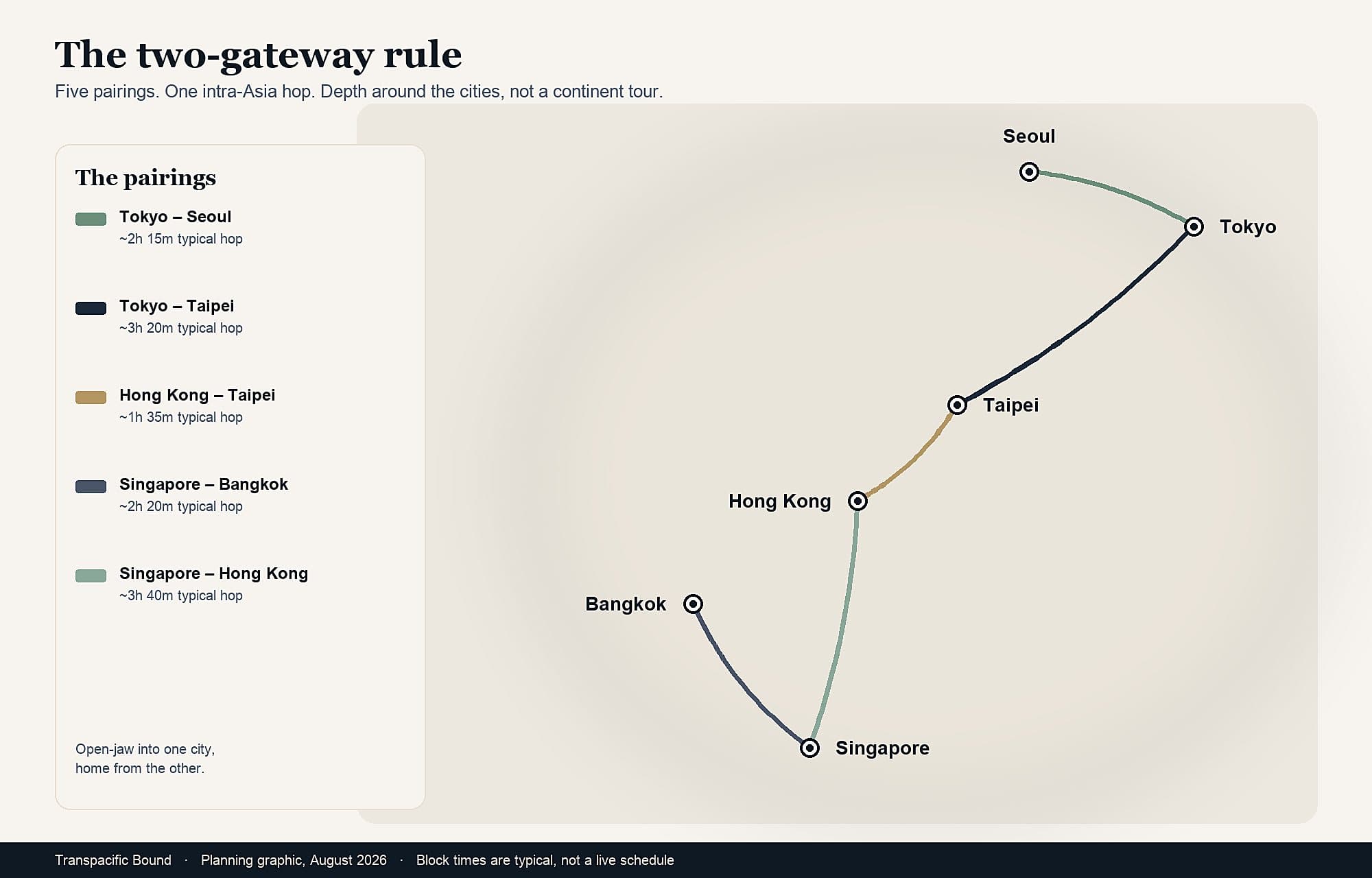
These are the combinations that keep the hop inside an afternoon and keep the whole trip inside one corner of the map. Tokyo plus Bangkok is two trips. Seoul plus Bali is two trips. The map above is the shortlist; the table is the version to screenshot.
Tokyo and Seoul are the classic Northeast pair: two capitals, a hop a bit over two hours, and enough North America lift that an open-jaw ticket is a normal thing to price. Tokyo and Taipei trade a little intensity for a city that forgives you at the night market. Hong Kong and Taipei are the compact pair—under two hours, two dense Chinese-speaking cities with different textures, the one to choose when you do not want a five-hour intra-Asia flight.
Singapore and Bangkok are the Southeast Asia pair, where heat is the real planning constraint rather than the clock. Singapore and Hong Kong are the two old entry cities: a longer hop, but still two dense, humid, late-eating places rather than a capital bolted onto a beach.
If a pairing is not on this list, ask whether you are planning a trip or collecting a map.
| Pairing | Why it fits | Typical hop |
|---|---|---|
| Tokyo + Seoul | Two capitals, easy open-jaw from the West Coast. | About 2 hours 15 minutes |
| Tokyo + Taipei | Tokyo’s intensity, then a city that feeds you without a reservation war. | About 3 hours 20 minutes |
| Hong Kong + Taipei | The compact pair. Dense, walkable, short hop. | About 1 hour 35 minutes |
| Singapore + Bangkok | Southeast Asia without a third capital. Watch the heat. | About 2 hours 20 minutes |
| Singapore + Hong Kong | The two classic entry cities. Longer hop, still one region. | About 3 hours 40 minutes |
Typical published block times on ANA, Korean Air, STARLUX, Cathay Pacific, Singapore Airlines, and Thai Airways. Confirm the live schedule before you lock the hotel.
When an open-jaw ticket works
Fly into the primary. Fly home from the secondary. You drop the backtrack, and the fare often lands close to a round-trip plus the hop—sometimes under it.
It works when both cities have real North America lift: Tokyo, Seoul, Taipei, Hong Kong, Singapore. It gets wobbly when the second city is a leisure island with thin long-haul. Bali is depth off Singapore, not a second gateway you exit home from, unless you have priced that exact fare and liked it.
Price the open-jaw before you price two round-trips, and book the intra-Asia hop separately only if the through-fare comes back worse than doing it yourself. Leave a buffer night if the flight home is a morning departure.
10, 14, and 21 days
Ten days is one gateway unless the hop is very short. Count seven or eight hotel nights in one city plus a day trip. Hong Kong and Taipei can squeeze into five nights and three once jet lag takes its cut. Tokyo and Seoul on ten days turns the second city into a weekend. Most first trips should stay put.
Fourteen days is where the rule really lives: eight nights and five, or seven and six. Keep the first three nights immovable in the primary city. Put the hop in the middle of the trip, never on the morning after you land.
Twenty-one days is two gateways plus one depth stay: Kyoto, Busan, Chiang Mai, Penang, Tainan. Chiang Mai is a hop from Bangkok, not a third international gateway. If Bali is on a three-week ticket, Singapore or Bangkok is the gateway and the island is the depth. Skip the extra capital.
The exceptions
Islands get their own rule. Bali, Palau, Okinawa, Cebu—the island is the point. One gateway plus the island. Do not also add Seoul to make the ticket look serious.
Visiting family is the other exception. The family city is non-negotiable. It can be the only gateway. A tourist capital on the same ticket is a bonus, not a requirement for the trip to count.
Work weeks are a different problem. An eight-day transpacific work trip is long enough to exhaust you and too short to adapt. This rule is for the holiday you actually get to keep.
Two gateways buys you presence instead of coverage. Pick the pair, learn one street in each city well enough to give someone directions, and leave the rest for the next ticket.
Related stories
A First Two-Week Trip to Asia
Tokyo–Seoul, Taipei–Hong Kong, or Singapore–Bangkok: how to spend two weeks without turning the Pacific crossing into a continent tour.
9 min · Aug 19, 2026
Hong Kong’s Visitor Recovery Is No Longer Just a Mainland Story
Hong Kong logged about 31 million visitors in seven months. Three in four still came from the Mainland. The change a traveler can feel is the overnight guest who books a hotel.
6 min · Aug 18, 2026
Your First Trip to Asia: A Culturally Fluent Starter Guide
How to pick your first Asian city, pace the week, and avoid turning the trip into heritage performance or continent tourism.
10 min · May 5, 2026
The Eight-Day Asia Work Trip Is Long Enough to Exhaust You and Too Short to Adapt
Eight days will not finish the clock shift. Protect sleep, keep one hotel, and ask whether one extra night costs less than a meeting you fumble.
8 min · Aug 8, 2026