
What It’s Like Exploring Yeosu’s Under-the-Radar Isles
This Saturday, Korea’s first World Islands Expo opens on the south coast. The halls are the headline. The ferries are the trip.
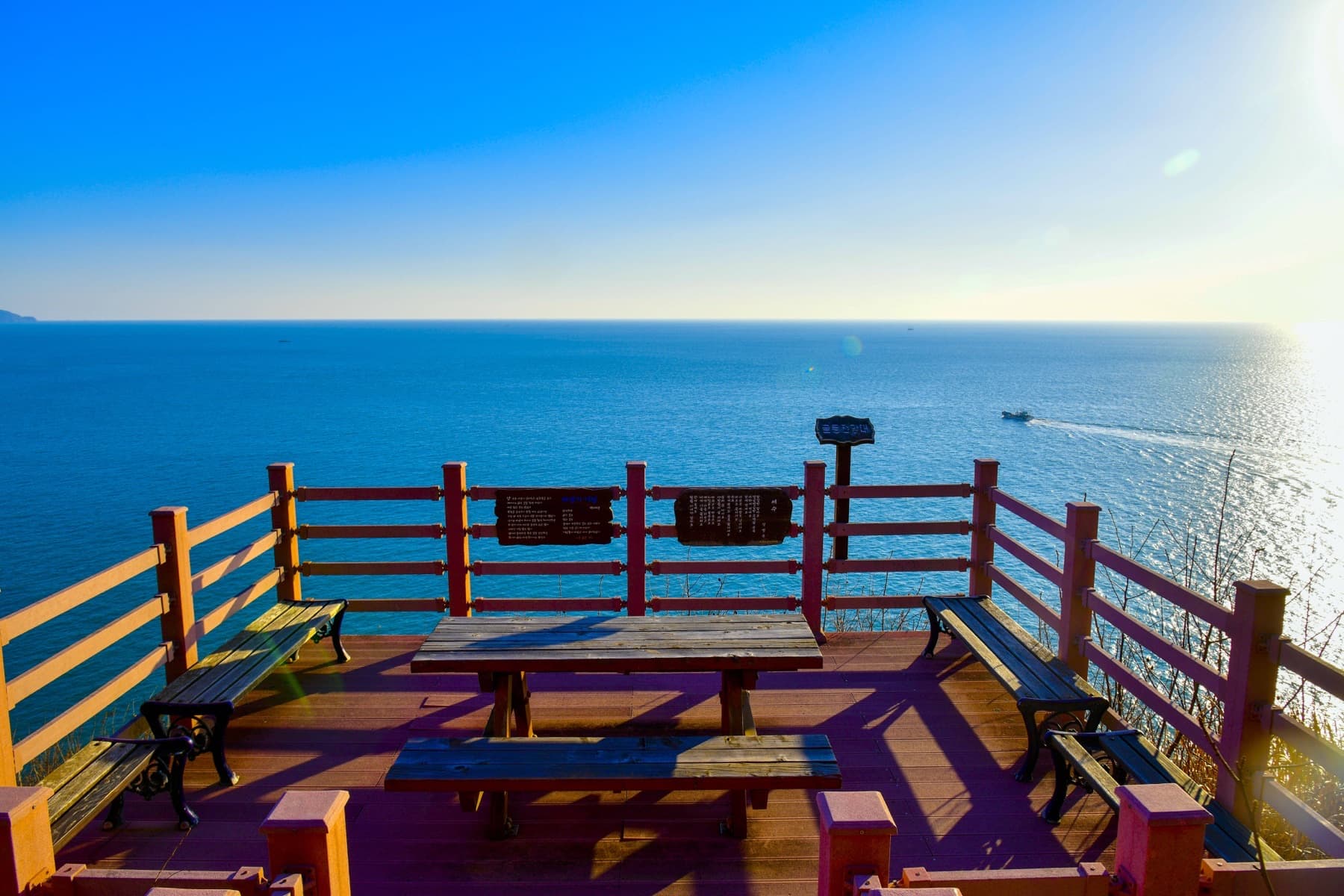
The first island does not ask you to believe in adventure. It asks you to walk.
From the Yeosu waterfront, Odongdo sits close enough that the sea looks like a canal. A stone breakwater—about three-quarters of a kilometer—carries you out on foot, past railings and day-trippers in windbreakers, toward a pine hill that still smells like a real forest. You can take the little Dongbaek train if you want. Most people do not. The point of Yeosu is that the islands start before you have finished negotiating with your itinerary.
That is the feeling international travelers still miss. Jeju remains the default “island Korea” brand: rental cars, volcanic calderas, honeymoon logistics. Yeosu is quieter and more useful—an industrial-coastal city that happens to own an archipelago. Locals already know the night market, the bridge lights, the seafood. Everyone else is only now getting a reason to look south.
On Saturday, September 5, the 2026 Yeosu World Islands Expo opens for sixty-one days, through November 4. Organizers call it the first large international fair built around islands: culture, ecology, and the futures of places that live by ferry timetable. The main site sits at Jinmo on Dolsan Island. Satellite programs run on Gaedo and Geumodo, with more activity at the older Yeosu Expo grounds near the KTX station.
The same Saturday, inland, the 16th Gwangju Biennale opens under the title *You Must Change Your Life*, directed by Singaporean artist and filmmaker Ho Tzu Nyen, and runs through November 15. Jeonnam–Gwangju’s tourism offices want the two events to share a longer stay: pavilion shuttle buses in Gwangju, regional sightseeing buses, October lodging discounts tied to the national travel-month campaign, and one-night packages that braid Yanglim-dong art walks with a Yeosu expo day. The visitor target floating around the expo—three million—is a goal, not a guarantee.
For a traveler, the news is simpler. Two months of national attention just landed on a coast that used to require a local tip.
Start with Odongdo because it teaches Yeosu’s grammar without a ticket booth. Trails loop past rock outcrops with nicknames you will forget and views you will not: the city stacked under misted hills, Dolsan Bridge’s white pylons in the channel, tankers moving like slow punctuation. Camellias make the island famous in winter; in early September you get greens and salt air instead. That is fine. The island still works.
Dolsan is the bridge island—cars, buses, Hyangiram Hermitage clinging to cliff rock, and now the expo’s main halls at Jinmo. Cross for a temple morning or an expo afternoon. Do not pretend the halls replace the coast. They borrow it.
Then buy a ferry ticket. Gaedo is roughly fifteen to twenty minutes from Baekya harbour: pebble beach, no bridge, the sudden quiet of a place that only boats can invent. Geumodo is a similar short hop from Singi’s harbour on Dolsan, with cliff trails—Bireonggil among them—and camping programs the expo has been advertising as island soft adventure. Bring your passport. Coastal passenger ferries treat photo ID as non-negotiable in a way city buses never do.
Geomundo is the overnight ask: about two to two and a half hours from the Yeosu coastal ferry terminal, often only a couple of sailings each way. Three islands clustered far enough south that a day trip turns into a rushed photograph. Beaches, rock, and a nineteenth-century British naval cemetery sit in the same small geography. Save it for a second Yeosu trip, or build a night into this one on purpose.
Think of the fair as temporary scaffolding around a permanent ferry map.
Hours at the main venue run 10:00 to 21:00; satellite islands often wind down by 18:00. The whole operation closes for one reset day on October 6. Adult day tickets list at ₩15,000 on the official site, with advance prices lower through September 4 and a cheaper night ticket from 17:00. Holders of a Gwangju Biennale ticket can show it at the expo box office for a discounted adult rate—currently listed at ₩11,000—which is the cleanest practical link between the two events if you are not buying a packaged tour.
Press-day coverage promised ferry discounts and “half-price island” incentives around Gaedo and Geumodo. Treat those as live offers to confirm at the terminal, not as a promise printed on your boarding pass. Opening weekend and late-September Chuseok travel will thicken the waterfront; midweek October will feel more like the Yeosu locals defend.
The halls will be crowded with pavilions from dozens of overseas local governments and a few international organizations. Walk them if you like that kind of density. Then leave. The trip still belongs to whoever picks the next boat.
You do not need the biennale to justify Yeosu. You might want it if contemporary art is already how you travel.
Ho Tzu Nyen’s edition is deliberately smaller and denser than past Gwangju spectacles—roughly forty-odd artists and collectives rather than a sprawling census. The main exhibition hall anchors the show; pavilion sites spill into neighborhoods such as Yanglim-dong, where walking tours of historic houses and artist studios start mid-September. From September 3 through mid-November, a pavilion circulation bus links the Biennale Exhibition Hall, the Asia Culture Center, and Yanglim for ticket holders on the day of their visit.
Food is the other reason to overnight inland. Gwangju’s October gastronomy week will put seasonal Jeolla cooking on a formal calendar, but the city’s reputation for namdo flavors does not wait for a festival. One night in Gwangju, one or two in Yeosu, is enough for a first southbound loop. Do not try to cover both events. Pick a morning of art or a morning of islands, then protect the evening meal.
From Seoul, the Jeolla Line KTX drops you at Yeosu Expo Station in about three to three and a half hours on a typical timetable—fast enough that a long weekend is honest, not heroic. Book reserved seats for the Saturday opening and for any Chuseok-adjacent days.
If you add Gwangju, ride the Honam KTX to Gwangju Songjeong in under two hours, then take the intercity bus toward Yeosu. The bus is the sensible link. The train route often backtracks through Iksan and wastes the afternoon you meant to spend on a breakwater.
Inside Yeosu, sleep near the Expo Station waterfront if nights and food matter most, or on Dolsan if you want expo mornings without a bridge commute. City buses and taxis cover the ferry harbours; schedules thin after dark, so treat late returns as a plan, not a hope.
Go this fall if you have already done Seoul’s palace-and-cafe week and want Korea’s south coast without defaulting to Jeju’s rental-car circuit. Go if a short ferry still feels like travel to you. Go if you can give Yeosu two nights—one for Odongdo and the harbor, one for a real island without a bridge.
Wait, or come after November 4, if your idea of a good trip is empty trails and no pavilion queues. The islands will still be there. The megaphone will not.
Either way, redraw the map before you book the next Korea ticket. Jeju sells the island fantasy. Yeosu sells the island habit: walk one, ferry another, sleep where the harbor lights stay on. This Saturday is simply when the rest of the country starts paying attention.
Related stories
Korea Just Bet on Gyeongju and Haeundae to Pull You Out of Seoul
Gyeongju and Haeundae are Korea’s first Global Tourism Special Zones. Here’s what the ministry is funding, and how to plan a trip that actually leaves the capital.
5 min · Jul 31, 2026
Asia’s Best Second Cities for a Longer Stay
Seven cities that reward a week or two: walkable food spines, enough culture to repeat days, and day trips that do not require another international flight.
8 min · Aug 5, 2026
Korea’s Sidewalks Are Crowded for a Reason
KTO’s H1 numbers show China still leading while Taiwan and the US sit far above 2019 baselines. Here’s what that density feels like in Seoul, and why Busan belongs on the map.
4 min · Jul 25, 2026
After the K-Drama: How to Do Seoul Without the Set-Jet Checklist
Ninety-four percent say K-culture sparked interest in Korea. Here’s a neighborhood-first week that does not turn into a location scavenger hunt.
6 min · Aug 3, 2026
Related global reads
Transpacific Bound
Korea Just Bet on Gyeongju and Haeundae to Pull You Out of Seoul
Transpacific Bound
Asia’s Best Second Cities for a Longer Stay
At the Banquet
The new Banquet: South Korea
At the Banquet
The Banquet guide to Seoul
Goldsea
Asia’s 8 most romantic places and the great love stories behind them