
Why SK hynix Shares Are So Volatile After Its Nasdaq Debut
A scarce new US security, a crowded AI-memory trade, and a leveraged Korean market collided in the first four US sessions.
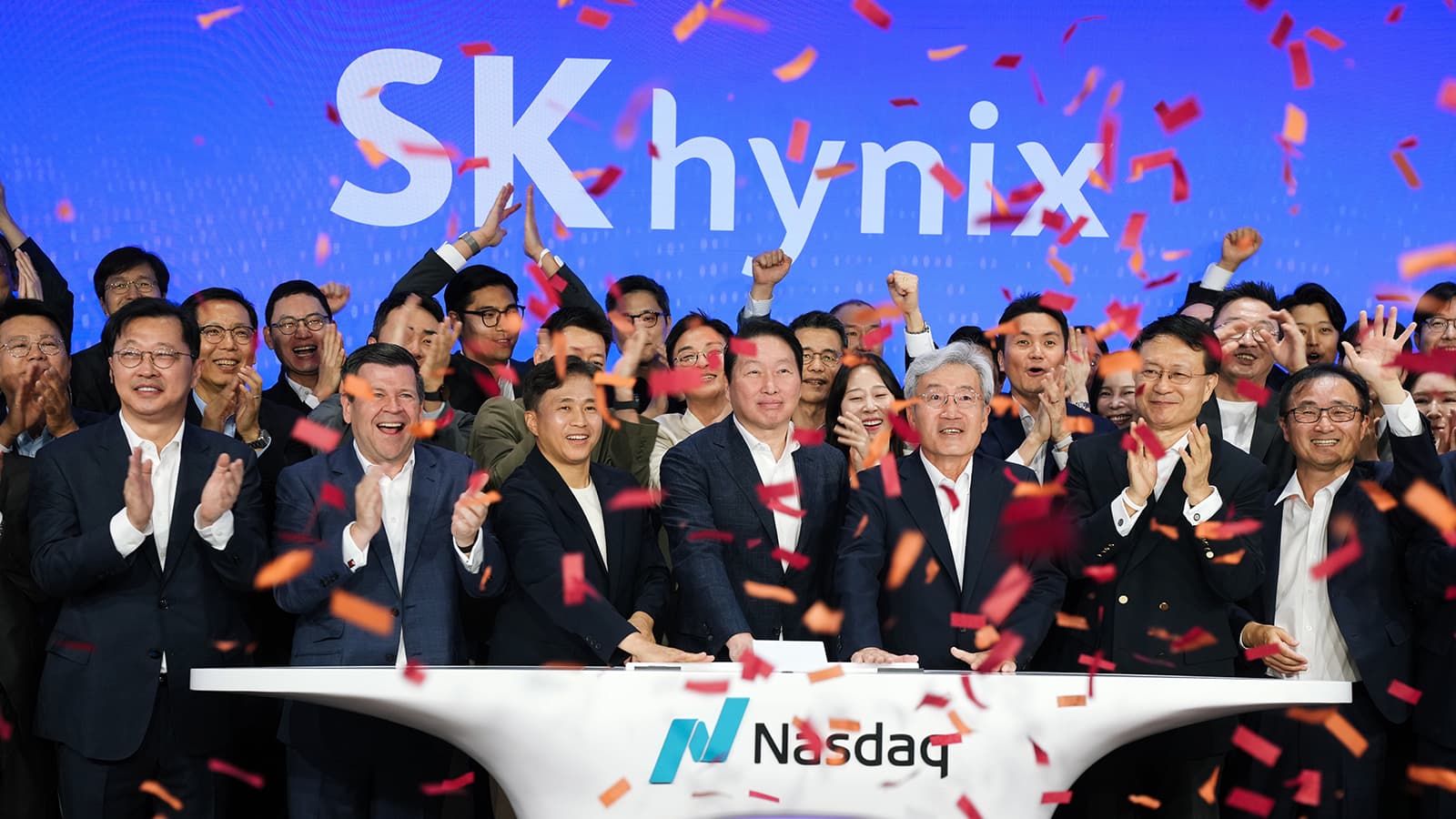
SK hynix began trading on Nasdaq on July 10 after offering its new American depositary shares at $149. They opened at $170 and closed their first session at $168.01. On their third trading session, July 14, they finished at $193.92. By July 15, they were back at $176.46.
The Korean common shares were making similarly sharp moves in a different direction and on a different clock. They fell 15.37 percent on July 13, their largest one-day decline on record according to LSEG reporting, then gained 3.69 percent on July 14 and 8.83 percent on July 15. On July 16 they reversed again, closing down 11.53 percent at ₩1.842 million as Asian chip stocks sold off. The New York session had not yet begun when that Seoul close was recorded. The company did not disclose an operating shock that matched those swings. Market structure, a crowded AI-memory trade, changing earnings expectations, and a turbulent Korean market all arrived at once.
The first thing to understand is that SKHY in New York and 000660 in Seoul represent the same chipmaker through different securities. Each Nasdaq ADS represents one-tenth of a Korean common share, so ten ADSs correspond to one ordinary share. SK hynix sold 177.9 million ADSs at $149, backed by 17.79 million newly issued common shares, for gross proceeds of about $26.5 billion.
That was a large capital raise with a small initial footprint relative to the company. The new shares represented about 2.5 percent of the pre-offering common-share count. The Korean shares backing the ADSs were scheduled for additional KOSPI listing on July 29. Early reporting also described constraints on creating new ADSs from existing Korean shares. Those conditions limited the usual arbitrage that helps two listings stay aligned.
The result was a striking gap. On July 14, SKHY’s $193.92 close implied a value roughly 51 percent above the Seoul common share after applying the ten-to-one ratio and a reported exchange rate. The comparison is imperfect because Korea and New York trade at different hours. It still showed that US demand was pressing against a scarce new float while the Korean market was processing a broad selloff, profit-taking, and forced rebalancing.
Options began trading on SKHY on July 14 and drew exceptional volume. Buying and hedging around those contracts likely amplified the ADS move, although public data cannot assign a precise share of the gain to options dealers. In Korea, analysts including Goldman Sachs pointed to leveraged single-stock exchange-traded funds as another amplifier. Products promising twice the daily move must rebalance as the underlying share changes, which can add buying into a rally and selling into a decline.
The volatility had begun before the Nasdaq bell. SK hynix reached a record intraday high of ₩2.987 million on June 25 after more than tripling during 2026. It closed July 1 at ₩2.56 million, dropped 14.57 percent the next day, and rebounded 10.88 percent on July 3. By July 14 it had traded as low as ₩1.678 million intraday, about 44 percent below the June peak. Comparing two intraday points captures the scale of the move without pretending that they were closing prices.
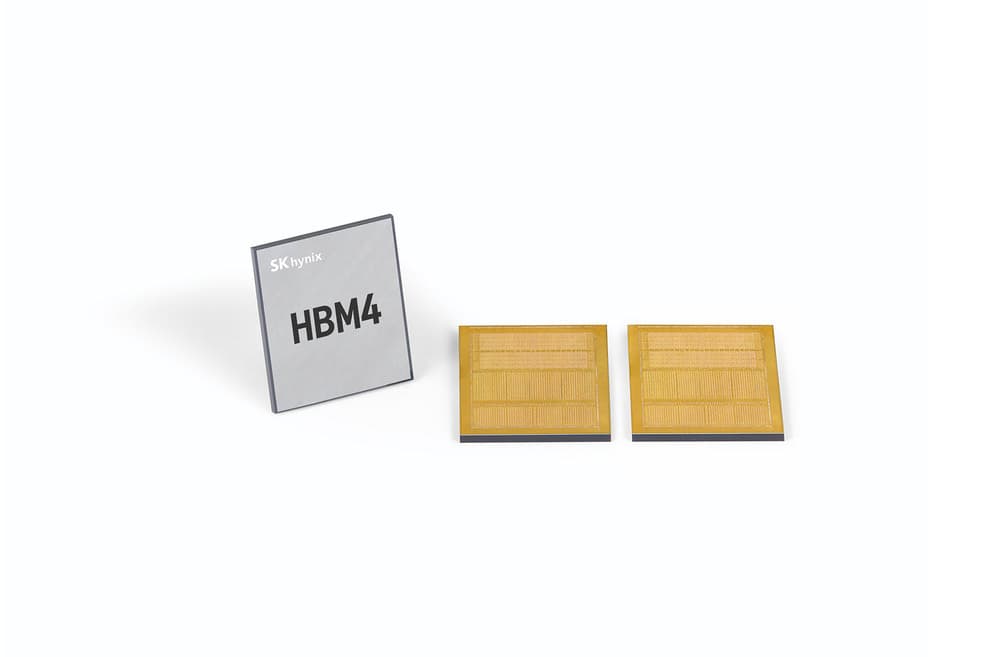
Part of the excitement rests on a real transformation in memory chips. SK hynix is the market leader in high-bandwidth memory, or HBM, by revenue in IDC estimates reproduced in its US prospectus. HBM stacks DRAM dies vertically and places extremely fast memory beside an AI accelerator. The arrangement feeds data to processors that would otherwise spend more time waiting, which is why HBM has become an essential component in systems built around Nvidia GPUs.
SK hynix and Nvidia formalized a multi-year technology partnership on June 8 covering next-generation memory, supply planning, design and manufacturing tools, and Nvidia’s Vera Rubin platform. Ten days later, SK hynix said it had shipped 12-layer HBM4E samples to major customers. The company did not name those customers in that announcement.
The operating figures behind the enthusiasm are unusually strong. SK hynix reported first-quarter 2026 revenue of ₩52.5763 trillion and operating profit of ₩37.6103 trillion, with HBM, high-capacity server modules, and enterprise solid-state drives supporting the result. Company-cited IDC estimates gave it 56.4 percent of HBM revenue in the quarter. These are research estimates rather than audited market-share figures, but they help explain the stock’s close association with investor expectations for AI infrastructure spending.
They also explain the sensitivity. Korean reporting has widely identified Nvidia as the unnamed external customer that accounted for 23.9 percent of SK hynix’s 2025 revenue, though the company’s filing does not name the customer. A close relationship with the leading AI-accelerator supplier provides order visibility and technical alignment. It also concentrates expectations around Nvidia’s product cycles, customer qualifications, and hyperscaler capital spending.
Competition remains active. Samsung Electronics has enormous scale across memory, logic, and foundry operations and has been improving its HBM4 position. Micron has expanded HBM supply and offers US investors a long-established Nasdaq-listed comparison. Nvidia has practical reasons to qualify multiple suppliers for capacity, resilience, and pricing. SK hynix’s current lead depends on yield, packaging capacity, thermal performance, and timely qualification continuing to hold.
Ordinary memory still matters too. HBM uses more wafer area and advanced packaging, which can tighten conventional DRAM supply as manufacturers redirect capacity. DRAM and NAND prices remain cyclical, and a low forward earnings multiple can reflect the possibility that estimates are near a peak. July opinions ranged from a Korean brokerage hold with a ₩1.85 million target to Barclays coverage of SKHY at $330; Morningstar’s reported fair value was $160 with very high uncertainty. These targets are analyst opinions based on different assumptions, not expected outcomes.
The company is also committing vast sums to capacity. Proceeds from the US offering are intended for the first fab in its Yongin semiconductor cluster, a Cheongju advanced-packaging facility, and manufacturing equipment including EUV tools. Those investments are necessary to support HBM growth, but memory history is full of periods when aggressive capacity and softer demand met at the wrong time.
Geopolitics adds another layer. SK hynix operates major facilities in Wuxi and Dalian, China. The United States approved equipment shipments for 2026 through an annual process after ending an earlier framework, providing operating relief without creating a permanent exemption. July’s Korean market also reacted to conflict involving Iran and the Strait of Hormuz, oil-price concerns, US inflation data, and changing global appetite for semiconductor shares.
The next firm checkpoint is July 29. SK hynix has scheduled its second-quarter earnings call for 9 a.m. Korea time, and the newly issued common shares backing the ADSs are also due to list on KOSPI that day. Earnings will test estimates for memory pricing, HBM shipments, and capital spending. The additional listing may change liquidity and conversion mechanics, although it does not guarantee that the US premium will disappear.
The evidence through Seoul’s July 16 close shows the securities moving much faster than the disclosed operating business. SK hynix entered the month leading the HBM market in the company-cited IDC data, with an unusually strong profit cycle, a major Nvidia partnership, and substantial concentration and execution risks. The Nasdaq offering then introduced a scarce US-traded instrument into a crowded theme while Korea absorbed its own leverage and macro shocks. The ratio, trading hours, and new-share structure explain why one company appeared to tell two different market stories.
Related stories
Why SK hynix’s Record Quarter Sent Its Stock, and Asia’s Chip Sector, Sliding
SK hynix posted the best quarter in its history on July 29. Investors sold anyway, joined by Samsung, Kioxia, and other Nvidia-linked suppliers across Asia.
7 min · Jul 30, 2026
Korea Just Pre-Sold $950 Billion of Memory
Kim Yong-beom put ~$950B on Korean–US chip cooperation as advance memory orders, not investment. Here’s the SK–Nvidia, Samsung–Broadcom, and Naver split, and what still sits in unconfirmed.
4 min · Jul 25, 2026
Samsung and SK hynix Are Turning Silicon Valley Into a Contract Signing
Kim Yong-beom says Samsung and SK hynix will announce major long-term memory contracts during Lee’s Bay Area stop. Watch the customers; wait on the figures.
5 min · Jul 24, 2026
Your Asia Business Trip Is Not a Vacation With Meetings
Heritage fluency helps at meals. It does not replace calendar discipline.
3 min · Jun 8, 2026
Related global reads
Transpacific Bound
Why SK hynix’s Record Quarter Sent Its Stock, and Asia’s Chip Sector, Sliding
Transpacific Bound
Korea Just Pre-Sold $950 Billion of Memory
AsiaMS
K-beauty crosses the $2 billion mark as U.S. household adoption triples
At the Banquet
The Banquet guide to Seoul
At the Banquet
The return of quiet luxury in Seoul